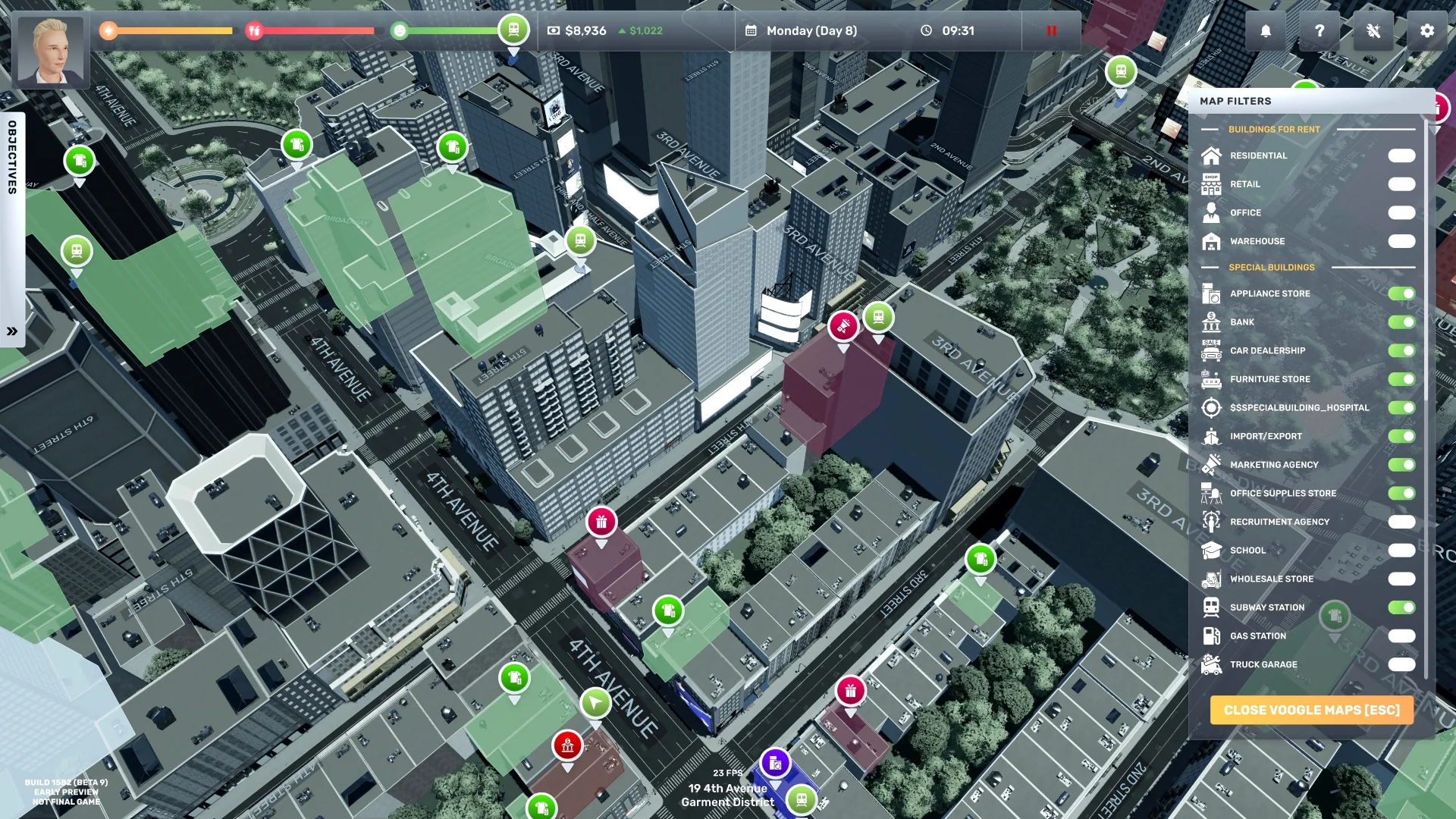
For an M1 retail building, start by comparing Electronics and Clothing; add Jewelry when MarketInsider shows demand and you can keep its stock supplied. These are candidates named in a recent 1.0 M1 discussion, not a verified profit ranking. An M1 property's 75-customer hourly cap is only a ceiling: a smaller operation can be easier to staff and serve, and the extra floor area does not create demand by itself.
The current community building reference lists Sixth Avenue 12, Murray Hill at 2,115 sq m, 75 customer capacity, and traffic 49; First Avenue 30, Midtown at 5,491 sq m, capacity 75, traffic 48; and Third Avenue 4, Midtown at 23,284 sq m, capacity 75, traffic 44. The first two are more practical candidates to inspect before committing to the exceptionally large Third Avenue 4; these listings do not provide your save's rent, competitor demand, or usable room layout.
| M1 candidate | Why players choose it | Check before leasing |
|---|---|---|
| Electronics | Named alongside Clothing as a strong M1 use in a recent 1.0 discussion; several product lines can use display space | Current product demand, import eligibility, purchase quotes, theft/security needs, and how many lines your budget can stock |
| Clothing | Also named as a strong M1 fit; multiple apparel lines can use a large retail floor | Neighborhood demand by clothing line, rack count, first inventory bill, staff coverage, and competitor count |
| Jewelry | Recent players report using M1 for Jewelry, but views differ on how much customer capacity it needs | Demand, competitor saturation, expensive inventory, security, and whether the actual customer flow justifies this footprint |
| Supermarket | Can use a broad product mix and needs room for shelves, refrigeration, checkout, and stock routes | Cold-storage and fixture cost, restocking workload, and whether you can fund a wide starting assortment; do not choose it only because the building is large |
If none of those products has useful demand in the district, do not force a retail fit. A recent discussion also points out that a gym may work in a smaller building, while player opinions differ on whether an M1's floor area is worth managing. Use M1 when its extra space solves a real layout or assortment need, not as a target to fill every tile.
Decide with a same-district check
- In MarketInsider, compare demand and competitor counts for Electronics, Clothing, and Jewelry in the district where the M1 is available. Keep only candidates with plausible demand.
- In the business setup screen, list products and required furniture. Check import eligibility and current order totals before counting a product as available.
- Compare rent and floor plan with the minimum layout: customer route, service points, employee stations, storage, and restocking access. Use only the area needed for expected flow.
- Estimate setup plus one operating cycle: fixtures + initial inventory + delivery/transport + wages + rent. Reject a candidate that uses the full cash reserve before opening.
- After opening, compare sales, stockouts, queues, wages, purchase costs, and rent over equivalent operating days. Keep the M1 setup only if its added assortment or capacity improves the result without constant manual restocking.
For a supermarket, the extra area only pays off if you can stock and replenish its broader mix; cold storage, fixtures, staffing, and supply add cost. It is a poor default when the budget only covers a few shelves. A gym or another service business may fit a smaller property if it does not need M1 customer capacity.
The recent M1 business discussion includes differing 1.0 player opinions: Electronics and Clothing are suggested, Jewelry is debated, and some players favor an all-in-one store. Treat these as candidate ideas, not measured outcomes. A separate capacity discussion records opposing views on M1 size and service workload, which is why the district and operating checks above matter.
Sources
- Big Ambitions building database — current community snapshot for address, area, capacity, traffic, and parking; checked September 26, 2026.
- Big Ambitions Supermarket guide — current 1.0 third-party setup, equipment, and staff reference; confirm requirements in the live UI.
- What business can use the M1 building? — recent 1.0 player suggestions and disagreement, used only to identify candidates.
- Big capacity vs Small capacity — recent player disagreement about M1 workload versus usable customer capacity.
- Official Big Ambitions announcements — Build 3680 import and delivery UI changes.